Paper companion · July 2026

From Vector Autoregressions to AI-based Time Series Forecasting

A guided route from classical multivariate models to transformers, foundation models, and diffusion-based generative forecasting.

Likai Chen·Weining Wang

5
connected modules
61
lecture slides
6
runnable code labs

The paper

One conditional distribution, many modelling traditions.

The review places modern neural forecasting inside the econometric tradition: every method is ultimately trying to learn the future conditional on the past.

Abstract

Forecasting is a central goal of time-series analysis. This review centers on three major developments in recent AI-based forecasting: transformers, large pretrained models for zero-shot forecasting, and diffusion-based generative forecasters.

Modern methods expand the classical template with more flexible dynamics, larger information sets and richer predictive distributions. Yet they often lack the inferential and structural tools that make classical models useful for testing, explanation and policy analysis.

VARTransformersFoundation modelsDiffusion
Learning map

Five modules, one connected path.

Each route combines the paper’s argument with the relevant slide range, a visual intuition, and a practical next step.

010:00–0:50

Classical multivariate models

Start with the system.

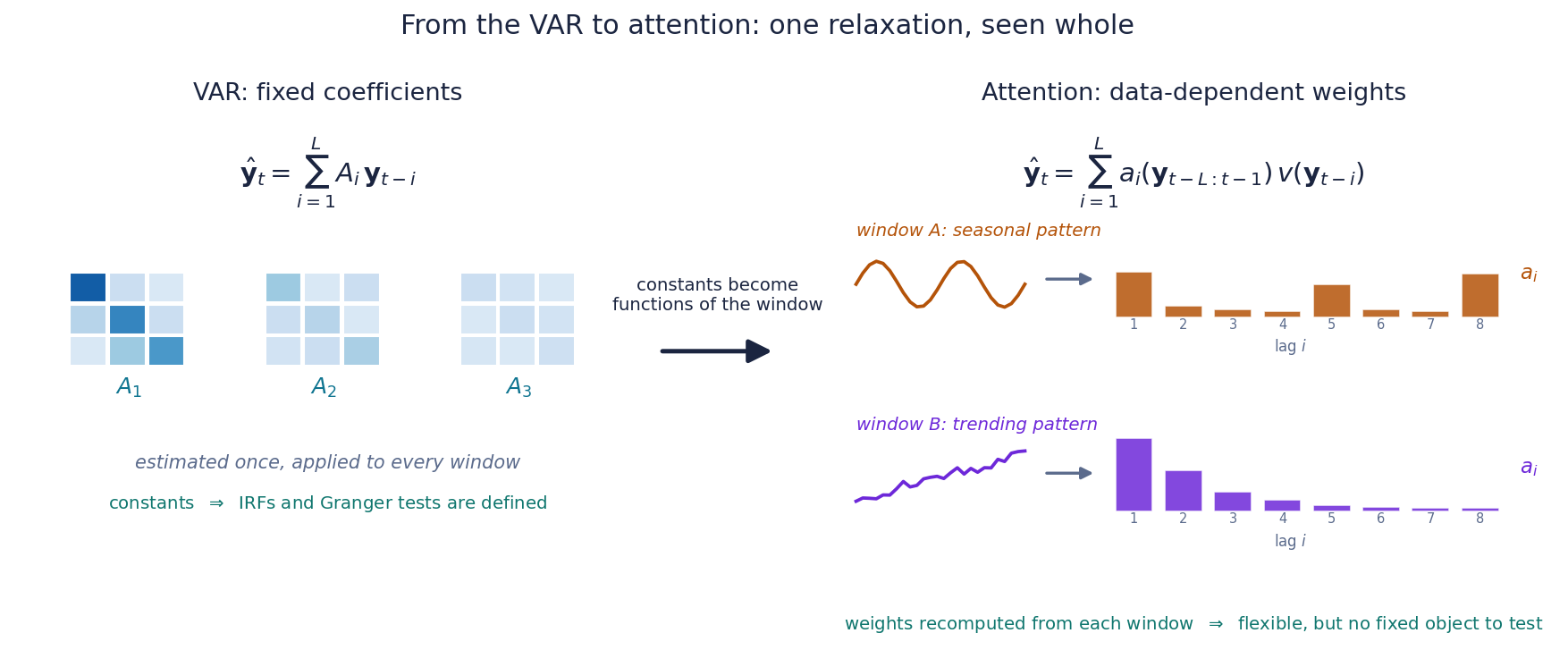
VAR and VARMA models, estimation by OLS, impulse responses, Granger causality, unit roots, cointegration and the error-correction model.

Diagram connecting vector autoregression coefficients to attention weights
020:50–1:50

The transformer era

Turn history into attention.

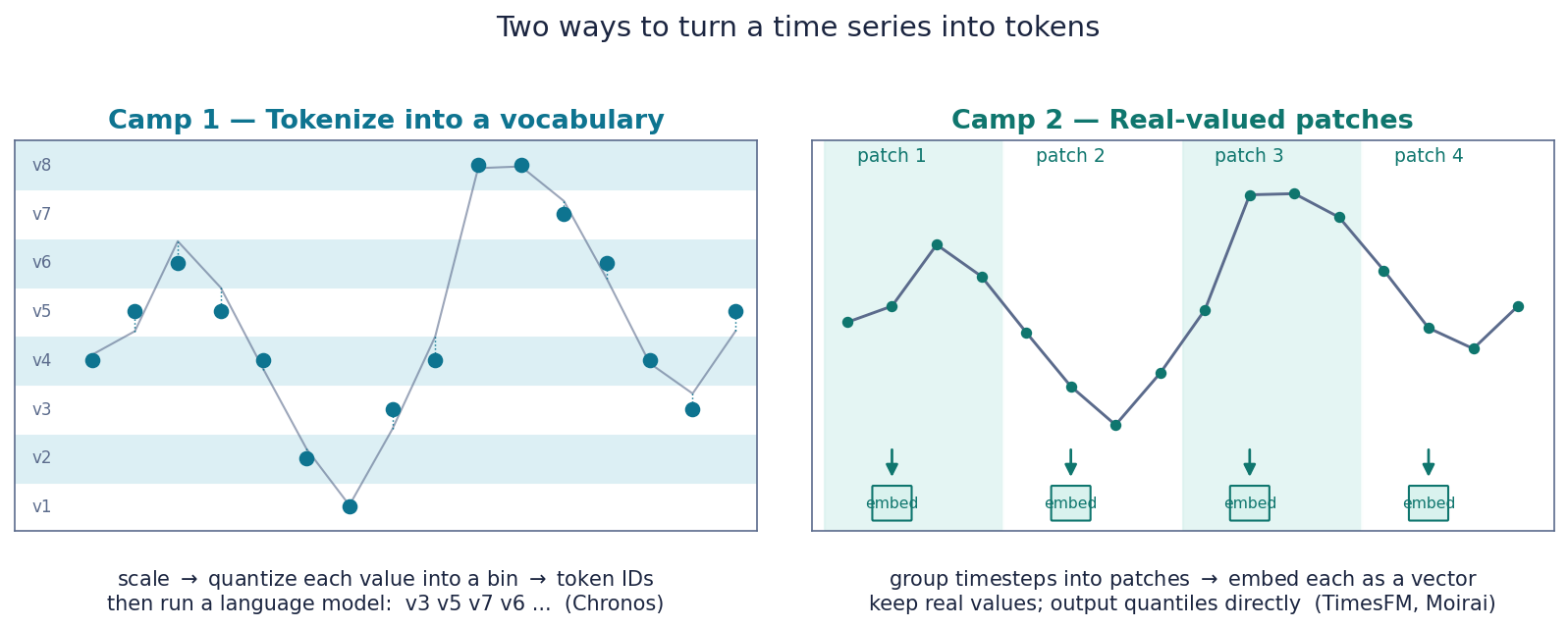
Forecasting targets and baselines, self-attention from first principles, model efficiency, DLinear, and patches as the atomic unit of prediction.

Time-series tokenization strategies from points to patches
031:50–2:45

Foundation models

Pretrain once, forecast many.

Zero-shot forecasting, values versus patches as tokens, TimesFM-3 and arbitration across models, honest benchmarking, and a minimal Chronos demonstration.

042:55–3:55

Diffusion forecasting

Generate plausible futures.

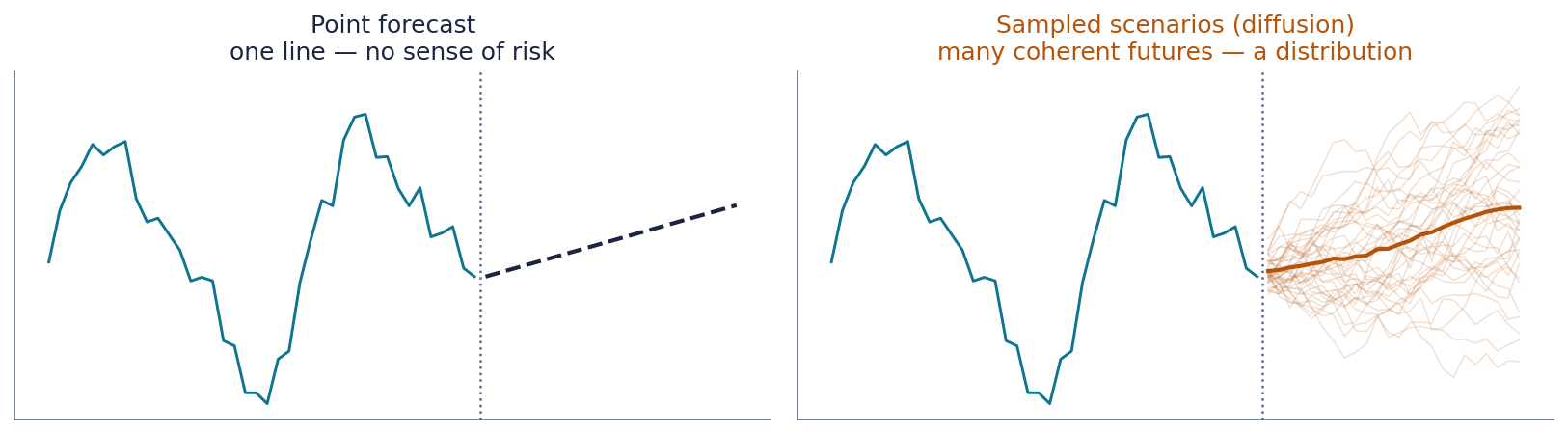
Predictive distributions, forward noising and reverse denoising, TimeGrad, forecasting as imputation, and coarse-to-fine generation.

Comparison of a point forecast and multiple sampled forecasting scenarios
053:55–4:45

Hands-on & practice

Make the ideas run.

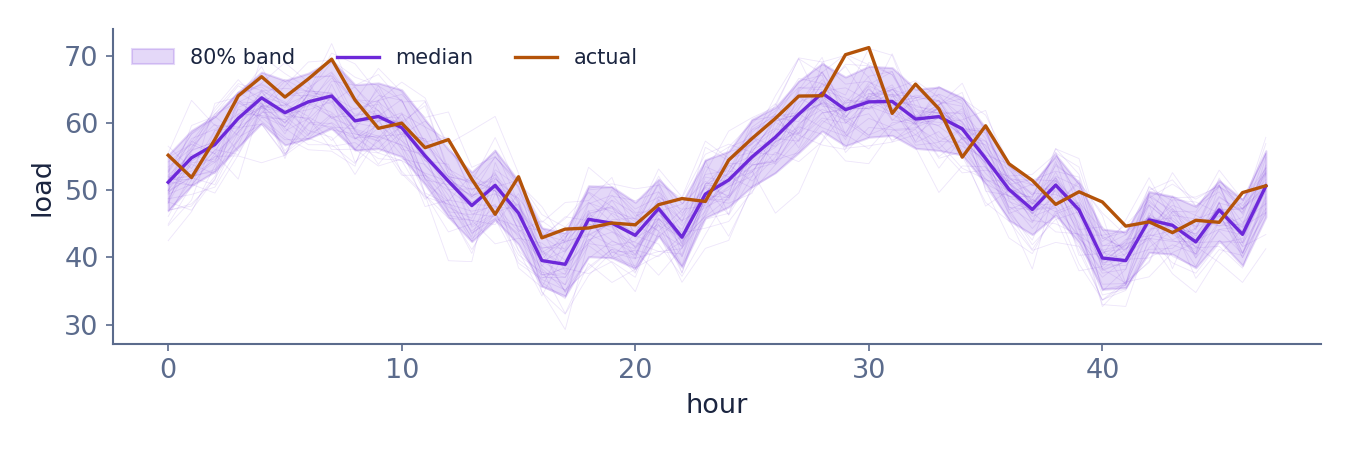
Six CPU-friendly exercises, honest forecast evaluation, MASE and CRPS, coverage, model choice, and open research problems.

Probabilistic forecast sample paths with an observed outcome

Lecture library

Read, watch and run, on one route.

The five class-recording slots are ready. Recording links can be dropped in as soon as they are available.

Module 01Classical foundations

Recording link needed

Module 02Transformer era

Recording link needed

Module 03Foundation models

Recording link needed

Module 04Diffusion models

Recording link needed

Module 05Hands-on practice

Recording link needed

Lecture slides

All 61 slides, inside the page.

Jump directly to a module, read in the embedded viewer, or download the complete half-day course deck.

Download deck ↓

If the deck does not appear in your browser, open the PDF directly.

Code resources

Theory you can execute.

The full lab runs on NumPy and Matplotlib, needs no GPU, and keeps every exercise small enough to inspect line by line.

$ python -m venv .venv
$ pip install numpy matplotlib
$ python exercises.py

# Optional foundation-model extension
$ pip install chronos-forecasting torch
01

Build the data

Trend, daily and weekly seasonality, noise and a held-out horizon.

make_series()
02

Estimate a VAR(1)

OLS, a Granger test and impulse-response coefficients.

fit_var1()
03

Beat the baseline

Seasonal naive forecasts, backtest intervals and MASE.

mase()
04

Write attention

Queries, keys, values, softmax weights and causal masking.

attention()
05

Noise and denoise

The diffusion forward process and a reverse-step scaffold.

q_sample()
06

Score distributions

Sample paths, coverage and the continuous ranked probability score.

crps_sample()

Living literature

The reading list that keeps moving.

Every paper links to its DOI, arXiv record, or official proceedings page. Search the core literature now, then add new work through one updateable data file.

Research watch · last refreshed September 2026

The library reads from data/references.json. Add one entry there and it appears here automatically.

Update on GitHub ↗

Loading references…

Loading the linked literature library…

Teaching kit

Everything for the next class.

A concise set of printable materials for teaching, study, and reproducible practice.

The authors

Econometrics meets modern forecasting.